
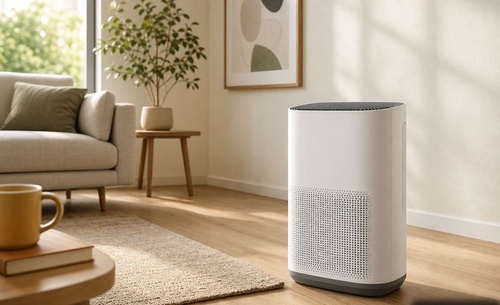

Knowing how to choose an air purifier is harder than it looks. You're faced with spec sheets full of acronyms, filters described in ways that sound interchangeable, and coverage claims that are impossible to compare at a glance. The confusion is real — but the underlying questions aren't that complicated. How big is your room? What are you actually trying to filter out? What will this cost you to run over time? Each of those confusing specs maps to one of those questions. This guide walks through the decision in that order — room size first, then filter type, then the true cost of ownership — so you can cut through the noise and pick the right unit.
Start with your room size
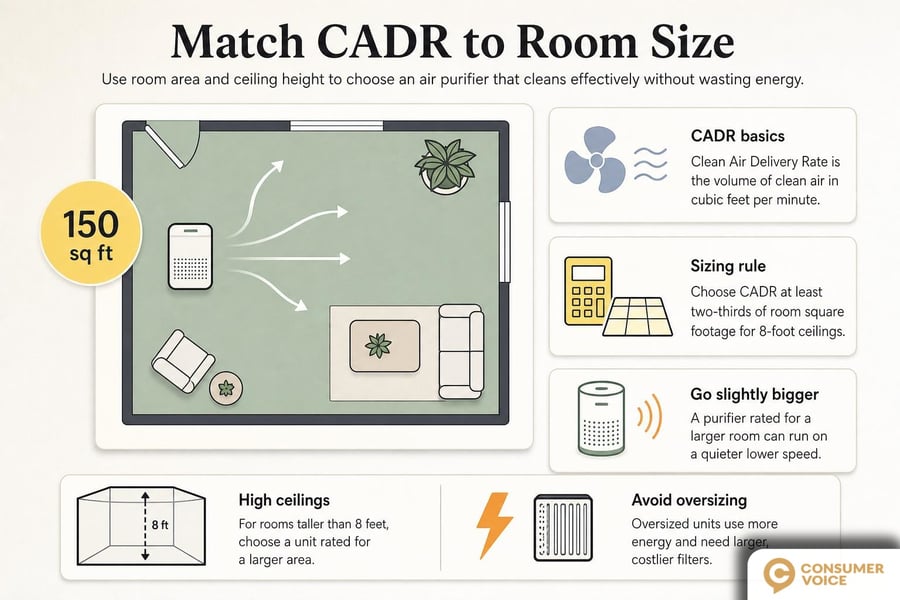
CADR — Clean Air Delivery Rate — is the standard measure for how much clean air a purifier actually produces. Specifically, it tells you the volume of clean air (in cubic feet per minute) the unit delivers, typically measured at its highest speed setting. Every CADR rating actually comes as three separate scores: one each for tobacco smoke, dust, and pollen, since particles of different sizes behave differently. A higher CADR means the unit cleans the air faster.
The practical sizing rule — originally an AHAM rule of thumb that both the U.S. Environmental Protection Agency and ENERGY STAR point consumers to — is straightforward: the purifier's CADR should be at least two-thirds of the room's square footage. So for a 150-square-foot bedroom, you'd want a CADR of at least 100. This rule assumes standard 8-foot ceilings — the volume assumption built into the calculation.
If your ceilings run higher than 8 feet, that two-thirds calculation undersells how much air the unit actually has to clean. Both EPA and ENERGY STAR advise choosing a unit rated for a larger area than the floor plan alone suggests in that case.
Here's where it makes sense to go a bit bigger deliberately. Running a unit at its highest speed tends to be noisy. If you buy a purifier rated for a room somewhat larger than yours, you can run it on a lower, quieter setting and still turn over the air effectively. That's a reasonable tradeoff for a bedroom or home office where noise matters.
Going too far in that direction works against you, though. Per ENERGY STAR, larger models use more energy, so a unit that's oversized for your space raises both your upfront purchase price and ongoing electricity costs — and typically means pricier filter replacements, since larger units use bigger filters. One other thing worth flagging: CADR as a rating system only applies to units that use airflow, so purifiers without fans can't be compared on the same terms as fan-driven models.
Pick the right filter for your problem
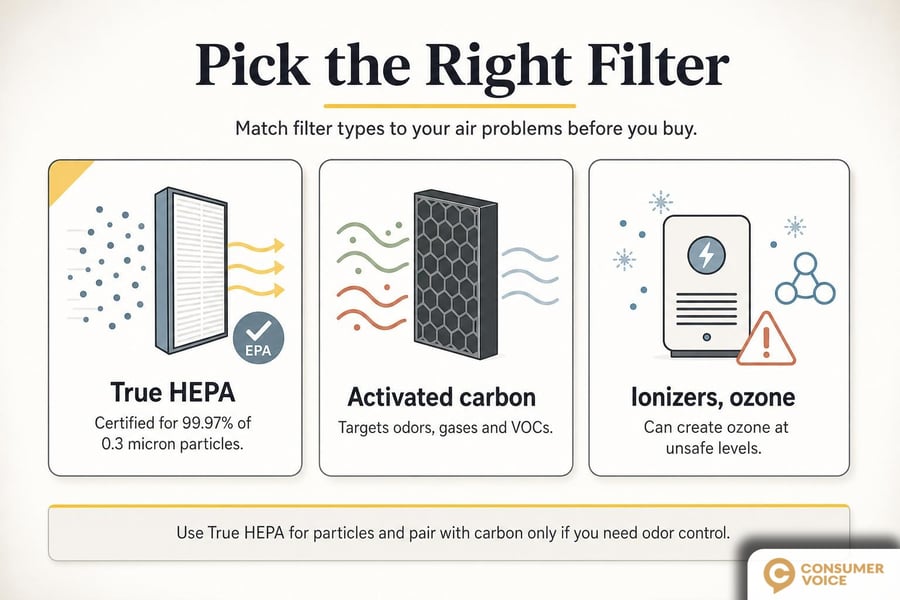
Your filter choice should be driven by what's actually in your air — particles, odors, or both — because no single filter technology handles everything.
True HEPA: the standard for particle removal
A True HEPA filter is certified to capture at least 99.97% of airborne particles at 0.3 microns in diameter, according to the U.S. Environmental Protection Agency. That size — 0.3 microns — is actually the hardest for a filter to trap, so the capture rate for larger and smaller particles is even higher. If you're dealing with dust, pollen, pet dander, mold spores, or fine smoke particles, a True HEPA filter is the right starting point.
One label to watch out for: filters marketed as "HEPA-type" or "HEPA-like" have not been certified to meet this standard. They may perform significantly worse and are not equivalent to True HEPA, regardless of how prominently the word appears on the box.
Activated carbon: for odors and gases
HEPA filters are excellent at catching particles, but they do nothing for gases, volatile organic compounds (VOCs — airborne chemicals released by things like paint, cleaning products, and furniture), or odors from cooking, smoke, or pets. For those, you need activated carbon, which works by adsorbing gas molecules onto its porous surface.
The catch is that not all carbon filters are created equal. The EPA notes that carbon filters perform best when they contain a large amount of filter material — a thin layer embedded in a prefilter won't do much. Carbon filters also need more frequent replacement than HEPA filters, typically every three to six months. If odor control matters to you, factor that into your running costs.
There's also no widely used performance rating system for gas removal the way there is for particles, so it's harder to compare products on this dimension.
Ionizers and ozone generators: proceed with caution
Ionizers work by releasing charged particles that cause pollutants to clump together and settle out of the air. Ozone generators deliberately produce ozone, claiming it neutralizes odors and contaminants. Both technologies carry real health risks.
The EPA warns that under certain use conditions, ionizers and other ozone-generating air cleaners can produce ozone at levels significantly above those thought harmful to human health. No federal agency has approved ozone-generating devices for use in occupied spaces. The California Air Resources Board caps ozone emissions from indoor air cleaners sold in California at no more than 0.05 parts per million (50 ppb) under Assembly Bill 2276, and recommends that ozone generators not be used in occupied spaces except for approved industrial purposes.
If a purifier markets itself primarily around ionization or ozone output, that's a reason to look elsewhere.
What certifications actually tell you
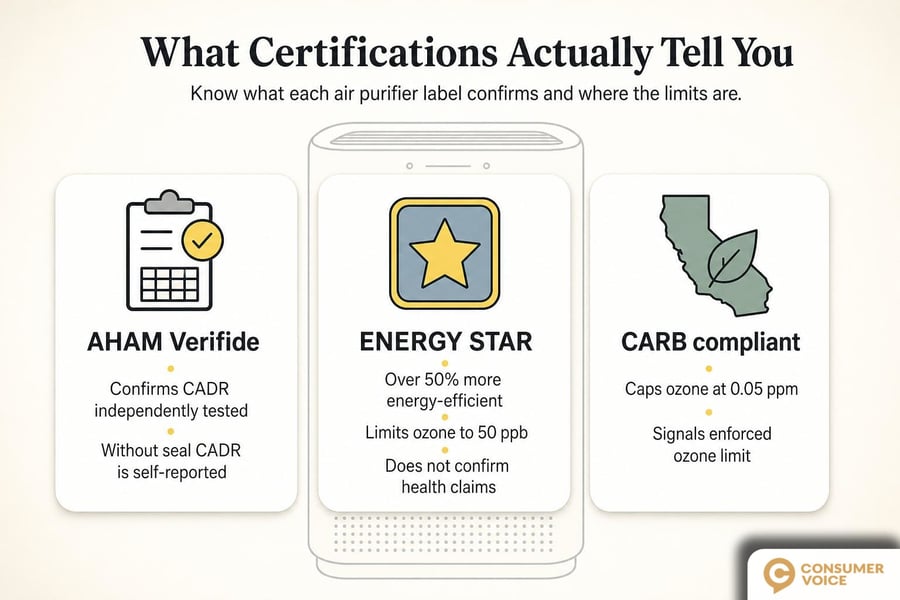
Certifications on an air purifier box are only as useful as you understand what each one actually measures — and what it doesn't.
The AHAM Verifide seal
CADR values are only meaningful if someone other than the manufacturer measured them. The AHAM Verifide seal tells you that happened. It means the unit's CADR was independently verified against ANSI/AHAM AC-1 — the industry standard for air cleaner performance testing, referenced by ENERGY STAR. Without that seal, any CADR figure on the box is self-reported by the manufacturer, with no third-party verification behind it. The same goes for air changes per hour (ACH) claims, which describe how many times per hour an air purifier can filter the air in a given room. Unless the product has been tested to the ANSI/AHAM AC-1 standard, those numbers are unsubstantiated.
Room-coverage claims are where this gets especially misleading. A manufacturer can print "covers up to 500 sq ft" with no independent data to back it up. If there's no AHAM Verifide seal, treat that figure as marketing, not measurement.
ENERGY STAR certification
ENERGY STAR means two specific things:
- The unit is more than 50% more energy-efficient than standard models — saving approximately 211 kWh per year and roughly $18–$40 annually depending on size, according to ENERGY STAR
- The unit emits no more than 50 parts per billion (ppb) of ozone, per the UL 867 standard
What ENERGY STAR does not mean: the EPA is not endorsing any health claims the manufacturer makes about that product. This is a common misreading. The EPA administers the ENERGY STAR program, and its logo on a box signals efficiency and a basic ozone limit — nothing more.
CARB compliance
The California Air Resources Board requires indoor air cleaners sold in California to cap ozone emissions at no more than 0.05 parts per million (ppm), or 50 ppb. Even if you're not in California, CARB compliance is a practical baseline worth looking for — it signals the product has met a defined ozone limit enforced by a regulatory body, not just stated in a spec sheet.
Think beyond the purchase price
The sticker price is only the beginning. A unit that costs less upfront but requires frequent, expensive filter changes can easily cost more over three to five years than a pricier model with modest maintenance needs.
Here's how to build a realistic cost picture before you buy.
Filter replacement adds up fast
HEPA mechanical filters typically need replacement every 6–12 months, with replacement filters running from about $80 to over $200 depending on the model. If you're also running an activated carbon filter — the layer that handles odors, smoke smell, and VOCs — plan to replace that one roughly every three to six months. That's up to four carbon filter purchases per year, and those costs compound quickly.
Before buying any unit, look up the cost and availability of its replacement filters. Some manufacturers make this easy; others quietly discontinue filters for older models.
Energy costs matter when the unit runs all day
Air purifiers need to run continuously to actually clean your air — running one only when you're home, or cycling it on and off, significantly reduces its effectiveness. That means the unit's energy draw becomes a real line item in your annual budget.
Over a three-to-five-year horizon, the efficiency gap between an ENERGY STAR certified unit and a standard model — roughly $18 to $40 per year — adds up alongside filter costs.
Placement and speed settings affect what you actually get
A few practical habits make a meaningful difference in how well your purifier performs:
- Run the unit on its highest speed setting when the room is unoccupied, then drop to a lower, quieter speed when you're in the space.
- If you plan to run it on low most of the time, buy a unit sized for a larger room than you have — that way, low speed still moves enough air to be effective.
- Keep the unit away from curtains, walls, and furniture that can block airflow. Unobstructed placement on all sides allows the unit to draw and push air freely.
Know what an air purifier can and can't do
The U.S. Environmental Protection Agency is clear that portable air cleaners alone may not resolve all allergy issues and cannot remove every pollutant from indoor air. The most effective strategies for indoor air quality are reducing pollution at the source and ventilating with clean outdoor air. Filtration works best as a supplement to those approaches, not a substitute for them.
Frequently asked questions
Do air purifiers actually help with allergies and asthma?
They can make a real difference, but they're not a standalone solution. A True HEPA filter captures common triggers like pollen, dust mite debris, and pet dander, which can meaningfully reduce your airborne exposure. That said, the U.S. Environmental Protection Agency notes that portable air cleaners, by themselves, may not address all allergy issues — the evidence for reducing asthma symptoms tied to small particles like cat dander and dust mite allergens is weaker than you might expect. Reducing the source — washing bedding, keeping pets out of bedrooms, vacuuming regularly — matters just as much as filtering the air.
Can an air purifier remove smoke, VOCs, and cooking odors?
It depends on the filter type. A True HEPA filter captures smoke particles effectively, but it does nothing for the gases that make smoke smell like smoke. Removing odors, VOCs, and cooking smells requires an activated carbon filter. Per EPA guidance, carbon filters work best when they contain a large amount of filter material — thin carbon layers in budget units tend to saturate quickly. Keep in mind there's no widely used performance rating system for gas-phase filters, so you're largely trusting the manufacturer on carbon quantity and quality.
What does ACH mean, and how many do I need?
ACH stands for air changes per hour — how many times a unit cycles the room's entire air volume in an hour. A higher ACH means the air gets cleaned more frequently. The EPA recommends at least 4.8 ACH for the room size where you place the unit, and ENERGY STAR echoes that guidance. If you're sizing a unit using the CADR two-thirds rule, a unit that meets that threshold will generally hit 4.8 ACH in the room it's rated for.
Is a bigger air purifier always better?
Not really. Oversizing does clean air faster, but according to ENERGY STAR, going well above the recommended ACH for your room tends to deliver minimal air quality improvements while raising your energy costs — and you'll also pay more upfront and spend more on filter replacements. Buy for your actual room size using the CADR two-thirds rule. If quieter operation matters to you, a modest bump up in size lets you run the unit at a lower speed setting, which reduces noise while still hitting your ACH target.
Next steps
Start with your room's square footage — that single measurement drives every other decision. Match it to a verified CADR, look for the AHAM Verifide seal to confirm those numbers are independently tested, then choose your filter type based on your actual problem: True HEPA for particles, activated carbon added in if odors or smoke are part of the picture. Before you buy, price out replacement filters, since ongoing costs often matter more than the sticker price.
Once the unit is home, placement and continuous operation matter as much as the hardware itself. And as the U.S. Environmental Protection Agency points out, an air purifier works best as one part of a broader approach — reducing pollution sources and keeping fresh air moving through your space does more than any filter alone.
When you're ready to put this framework into practice, comparing specific models side by side is the fastest way to find the right fit for your room and budget.
Our Methodology: BuyersReport evaluates air purifiers using filtration efficiency, air quality improvement, noise levels, energy consumption, pricing, customer feedback, and editorial review. We focus on helping readers compare filter types, coverage area, noise output, energy efficiency, and overall value.