
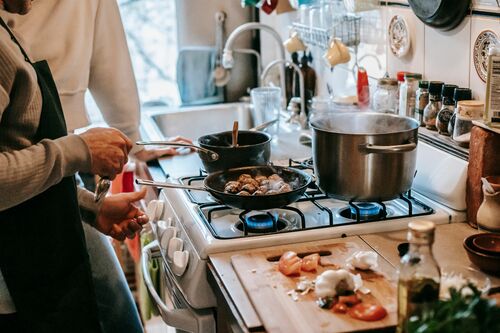

Cooking fires were 4.2 times as common on Thanksgiving as on non-holidays, and New York and Pennsylvania metros reported some of the highest shares of cooking-related home fires.
Key Insights
- There were 320% more home cooking fires on Thanksgiving 2025 compared to regular Thursdays.
- Cooking caused 41% of reported residential fires in 2025, or an estimated 206,699 cooking fires nationwide.
- New York, Massachusetts, New Jersey, Rhode Island, and Pennsylvania had the highest shares of cooking-related home fires among all states.
- Two Pennsylvania metros, Scranton–Wilkes-Barre and Pittsburgh, led the metro ranking, with cooking behind roughly 90% and 88% of reported residential fires, respectively.
- One in five Americans has had a cooking fire, and 58% say they frequently watch TV, use their phone, or multitask while cooking.
- Owning a smoke detector is common, but few test them out: 85% have one in or near the kitchen, yet only 13% tested it in the past month.
Thanksgiving Day provides the perfect recipe for cooking fires: crowded kitchens, multiple dishes cooking simultaneously, and tons of distractions from guests to the big games.
In fact, last year, there were 4.2 times as many residential cooking fires on Thanksgiving Day as on a comparable non-holiday, or a 320 percent increase. Our new consumer survey also found that one in five Americans has had a fire break out while cooking.
As Thanksgiving kicks off the year's busiest cooking stretch, BuyersReport.org's analysis pairs federal structure fire data with a survey of 1,187 American adults. We’ll show which cities see cooking contribute the most to house fires and which everyday habits and tools may put households at risk.
Cooking Fires Were 4X More Common On Thanksgiving
Thanksgiving regularly lands near the top of the list of the riskiest days for cooking fires in the U.S. Juggling tasks, entertaining guests, and simmering pots of hot oil are a recipe for trouble.
Our review of the most recent U.S. Fire Administration National Fire Incident Reporting System (NFIRS) data shows residential cooking fires were 320 percent more common on Thanksgiving 2025 than on a typical Thursday. That was an even steeper spike than in 2024, when fires were up 260 percent on Thanksgiving compared with an average Thursday.
The numbers show how quickly cooking-fire risk spikes on the holiday. When a cook is making several dishes in a crowded kitchen and slipping away to catch the game or help relatives, it is easy to lose track of what is on the stove or in the oven.
Cooking fires can cause injuries, force families out of their homes, and cause serious property damage, which is why careful, focused cooking matters every day of the year.
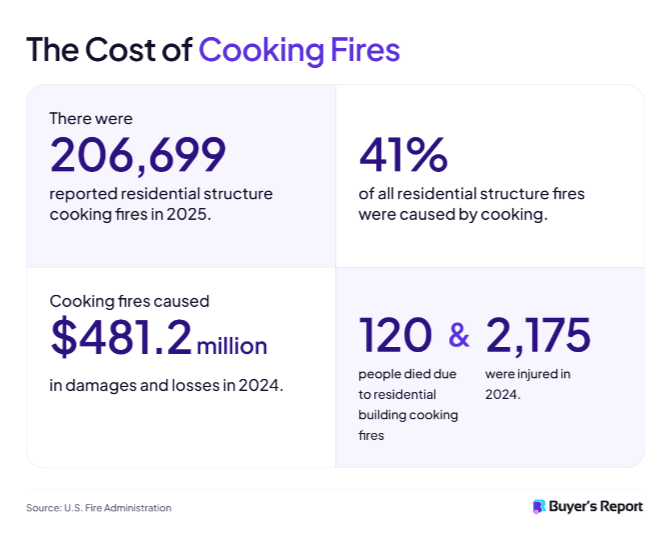
The U.S. Fire Administration estimated residential cooking-fire losses at $481.2 million in 2024 alone. There is good news: from 2015 to 2024, residential cooking fires fell 15 percent and inflation-adjusted dollar losses fell 11 percent. Even so, 120 people died in home cooking fires in 2024, and 2,175 were injured.
Even a quickly extinguished fire can leave a household dealing with smoke, ruined appliances, and repairs. Prevention, focus, and a rehearsed response can keep a small incident from becoming a much bigger emergency on Thanksgiving and every day of the year.
States Where Cooking Causes the Most Fires
Across the country, cooking caused about four in ten residential fires in our latest analysis of NFIRS data, but that share varies widely by state. Nationwide, cooking contributes to anywhere between 15 and 72 percent of fires, depending on the state. Northeast states fill most of the top spots for the highest share of reported home fires caused by cooking.
States With the Highest Share of Residential Cooking Fires in 2025
| State | Percentage of reported fires caused by cooking | Estimated cooking fires per 100,000 residents | Total reported residential cooking fires |
|---|---|---|---|
| New York | 72% | 304.9 | 60,995 |
| Massachusetts | 68% | 117.5 | 8,407 |
| New Jersey | 64% | 82.4 | 7,866 |
| Rhode Island | 62% | 98.1 | 1,094 |
| Pennsylvania | 60% | 175.1 | 22,865 |
| Delaware | 58% | 94.0 | 997 |
| Hawaii | 45% | 17.6 | 253 |
| Connecticut | 43% | 50.1 | 1,846 |
| Indiana | 41% | 308.9 | 21,537 |
| Wyoming | 41% | 586.9 | 3,456 |
New York ranked first, with cooking causing 72 percent of reported residential fires in the state, close to three out of every four fires. Massachusetts, New Jersey, Rhode Island, and Pennsylvania, all in the Northeast, complete the top five.
At the other end of the ranking, cooking played a much smaller role in fires in some states. New Mexico, Alaska, Montana, Arkansas, South Dakota, and Mississippi had the lowest shares of cooking-related residential fires, with cooking behind fewer than 20 percent of fires in each.
Metro Areas Where Cooking Fires Dominate
The regional pattern of cooking fires is even sharper at the metro level, where Northeastern metros hold nine of the ten top slots in the updated ranking.
20 Metros With the Highest Percentage of Residential Cooking Fires
| Metro area | Percentage of reported fires caused by cooking | Total reported residential cooking fires |
|---|---|---|
| Scranton–Wilkes-Barre, PA | 90% | 106 |
| Pittsburgh, PA | 88% | 268 |
| New York–Newark–Jersey City, NY–NJ | 81% | 16,715 |
| Kiryas Joel–Poughkeepsie–Newburgh, NY | 80% | 184 |
| Boston–Cambridge–Newton, MA–NH | 77% | 3,640 |
| Albany–Schenectady–Troy, NY | 77% | 163 |
| Trenton–Princeton, NJ | 71% | 155 |
| Worcester, MA | 68% | 881 |
| Atlantic City–Hammonton, NJ | 67% | 196 |
| Ann Arbor, MI | 64% | 103 |
| Buffalo–Cheektowaga, NY | 63% | 238 |
| Bloomington, IL | 57% | 80 |
| Providence–Warwick, RI–MA | 54% | 430 |
| Portland–South Portland, ME | 52% | 79 |
| Racine–Mount Pleasant, WI | 52% | 85 |
| St. Louis, MO–IL | 51% | 1,106 |
| New Haven, CT | 50% | 129 |
| Champaign–Urbana, IL | 50% | 95 |
| Chicago–Naperville–Elgin, IL–IN | 50% | 3,382 |
| Des Moines–West Des Moines, IA | 49% | 116 |
Scranton–Wilkes-Barre had the highest share of residential structure fires caused by cooking. Cooking contributed to 90 percent of reported residential fires in that metro area last year. Pittsburgh followed, with cooking sparking 88 percent of its residential structure fires. In October 2025, a fire in Pittsburgh's Point Breeze neighborhood started when a dog trying to reach food accidentally turned on a burner left on the stove, according to city fire investigators. No one was home, but the kitchen sustained significant damage.
The New York–Newark–Jersey City metro ranked third, with cooking contributing to 81 percent of its reported residential fires. As an example, a kitchen fire in a Bronx apartment building injured 10 people, including a firefighter. A relative of one resident said she was deep-frying chicken when hot oil erupted.
Cooking Fires in the 10 Largest Metro Areas
| Population rank | Metro area | Percentage of reported fires caused by cooking | Total reported residential cooking fires |
|---|---|---|---|
| 1 | New York-Newark-Jersey City, NY-NJ | 81% | 16,715 |
| 2 | Los Angeles-Long Beach-Anaheim, CA | 41% | 1,360 |
| 3 | Chicago-Naperville-Elgin, IL-IN | 50% | 3,382 |
| 4 | Dallas-Fort Worth-Arlington, TX | 33% | 157 |
| 5 | Houston-Pasadena-The Woodlands, TX | 25% | 79 |
| 6 | Atlanta-Sandy Springs-Roswell, GA | 30% | 73 |
| 7 | Washington-Arlington-Alexandria, DC-VA-MD-WV | 29% | 612 |
| 8 | Miami-Fort Lauderdale-West Palm Beach, FL | 46% | 535 |
| 9 | Philadelphia-Camden-Wilmington, PA-NJ-DE-MD | 47% | 913 |
| 10 | Phoenix-Mesa-Chandler, AZ | 27% | 222 |
Because of its size, the New York metro area logged the most cooking fires of any metro listed, at over 16,700 in one year. Even among the top 10 largest metro areas in the U.S., New York still had the greatest percentage of residential fires caused by cooking. It blazed ahead of the second-place major metro, Chicago-Naperville-Elgin, where cooking contributed to 50 percent of residential structure fires.
Stovetops Contribute to Four in Ten Cooking Fires
Most fire reports we analyzed did not include any information on what kitchen equipment was involved in the fire. Among the more than 5,000 residential fires where equipment data was recorded, ranges and stovetops were the most common culprits, involved in 43 percent of residential cooking fires. Ovens and rotisseries followed at eight percent, with microwaves at five percent.
Ranges, stovetops, and fireplace inserts share one feature: they heat food or living space with open flames or exposed hot surfaces. Grease, oil, loose sleeves, dish towels, and packaging can catch fire quickly when they contact that kind of heat. Enclosed appliances such as ovens and microwaves keep the heat contained and secure doors, which helps explain why they account for a smaller share of fires.
Deep-frying appliances account for only one percent of fires, according to equipment data. Though this is a small percentage of all cooking fires, these fires can escalate quickly, as one of our study participants shared: “My brother-in-law wanted to deep fry a turkey without reading up on it first. It was a disaster! He dropped the turkey in, and flame shot up sky-high, igniting the water sprinklers over it,” they explained.
Federal data shows where cooking accounts for the largest shares of reported home fires and which equipment shows up most in reported cooking fires. Next, our consumer survey looks at the everyday habits that can lead to fires in the first place.
Distraction, Multitasking, and Missing Alarms: The Habits Behind the Flames
BuyersReport.org's new survey backs up what firefighters already know: even experienced home cooks can lose focus. More than one in five Americans (21 percent) said they have had a fire while cooking.
Distractions are everywhere, and they can turn a kitchen chaotic. Fifty-eight percent often multitask at the stove, checking a phone, watching TV, or chatting while food cooks, and another 37 percent do so sometimes or rarely.
Twenty-eight percent always or often walk out of the room while food is cooking. That habit carries real risk: the U.S. Fire Administration names unattended equipment as the top contributing factor in nonconfined home cooking fires.
The survey exposed uneven follow-through on fire prevention. Many people practice good habits at least occasionally, such as setting a timer or wiping grease off the stove, while others never do. Many also regularly do things that invite distraction and fire, like leaving the room, watching TV, or even dozing off while food cooks. Much like driving, cooking is best done with full focus and no multitasking.
Age made a notable difference in several of these habits. In every age group under 45, one-quarter of respondents said they cook under the influence of alcohol or drugs at least sometimes, versus 13 percent of adults 45–59 and 10 percent of those 60 and older. While many enjoy a glass of wine while cooking, overindulging can cause distractions and slower response times, increasing fire risk.
Younger adults were also statistically more likely to report accidental appliance errors than older ones, such as accidentally turning appliances on. Older respondents also cleaned cooking areas more consistently: 44 percent of adults 60 or older always cleaned grease or food buildup, compared with 27 percent of those 18–29.
Fire Safety Gear in the Kitchen
Even the most careful cook can still face a fire, so every household needs working smoke alarms and the right safety equipment on hand.
| Home fire safety equipment | Percentage of respondents who have equipment in or near the kitchen |
|---|---|
| Smoke detector | 85% |
| Fire extinguisher | 65% |
| Fire-resistant oven mitts | 33% |
| Fire blanket | 9% |
| None of the above | 5% |
Source: BuyersReport.org survey of 1,187 U.S. adults. Multiple responses allowed.
Smoke detectors topped the list, but having one doesn't guarantee it works. Just 13 percent said they had tested theirs within the past month, and 24 percent said it had been over a year or they could not recall.
The U.S. Fire Administration advises testing smoke alarms every month, and they need to be replaced within ten years of their manufacture date. Put alarms on each level of the home and both inside and outside sleeping areas. Follow placement instructions, including how far to keep alarms from cooking appliances, to reduce nuisance alarms.
Simple Ways to Prevent Cooking Fires This Thanksgiving
You don’t have to be a master chef to prevent cooking fires. By using quality cookware, staying focused, and keeping the cooking area clean, you can reduce your risk of fires this Thanksgiving:
1. Replace old or damaged cookware. Fire risk can build quietly as pans warp, handles crack, and cords fray, so look over your kitchen gear before the holiday cooking begins. Steve Leasure of Rainbow Restoration, a home restoration company, lists what to check. “Look for warped pans, cracked or melted handles, badly burned utensils, frayed cords, or damaged plugs. Unusual burning smells can also signal a problem,” said Leasure. “If something looks damaged or isn’t working properly, stop using it until it’s repaired or replaced.”
Appliances deserve the same scrutiny as your utensils and pans. Dennis Godynuk, an appliance expert and the owner of Comfort Appliance and Refrigeration Repair, points to two warning signs: “If your kitchen appliance has a melted part or a burnt section, it needs to be replaced to reduce the fire risk. If you turn on the stove or oven and there's repeated sparking near the electrical boxes, it's also a fire hazard,” Godynuk advised.
2. Choose safe cookware materials. Pick sturdy pots and pans that suit your stove and cooking method, with strong handles and well-fitting lids, and always follow the manufacturer's heat limits. What a pan is made of, and how thick it is, also affects how safely it handles heat, says recipe developer Carrie Barnard: “The safest option with any metal cookware is to use pots and pans that are made of 100% metal, without any built-in plastic or wooden accents. I also recommend avoiding cheap, thin pans, as they can quickly overheat and create uneven hot spots, potentially causing fats or oils to smoke or catch flame,” Barnard shared.
3. Stay focused and avoid distractions. Stay in the kitchen while you use the stovetop, and switch off the burner if you have to step away. Timers and alarms can help you track several dishes, but they do not replace watching the food. “You need to set clear boundaries and minimize distractions,” said Barnard. “Make sure to let other people, especially children, know that they should not be demanding your attention while you are focused on cooking.”
4. Use fryers with great caution. The NFPA advises against outdoor gas-fueled fryers that submerge a turkey in hot oil for good reason. These fryers increase the risk of spills, fires, and serious burns. Jeffrey Nadrich, founder and managing attorney at Nadrich Accident Injury Lawyers, a firm that handles burn-injury cases, explains the risks and the safer alternatives. “Typically, turkey fryers aren’t equipped with thermostat controls, so the oil can overheat. They also may tip over and spill hot oil onto an open flame. For that reason, if you want a fried turkey, it’s a better idea to use an electric fryer with a thermostat control or an oil-free fryer,” Nadrich advised. “Under no circumstances should you leave cooking oil or a fryer unattended. If you decide to fry a turkey, make sure it’s thawed and dry. Ice and water hitting hot oil can cause it to erupt.”
5. Keep the cooking area clean and ventilated. Move towels, packaging, curtains, and other flammable items away from the stove. “Stay in the kitchen while cooking, keep towels and other flammable items away from the stove, and clean up grease regularly. If you have a vent hood over your stove, make sure it’s clean and working properly to help remove heat, smoke, and grease-laden air,” said Leasure.
Thanksgiving should be about gratitude, not heartache and stress. A few added precautions, especially in the kitchen, can help everyone enjoy a fire-free, safe, and happy holiday.
Methodology
Public Fire Data
We analyzed U.S. Fire Administration (USFA) National Fire Incident Reporting System (NFIRS) records from 2020–2025, focusing on residential cooking fires in 2025 and changes since 2024. We checked records for duplicates, inconsistencies, and gaps in department reporting.
Because reporting is incomplete, we estimated state and national totals using historical reporting patterns, comparable fire departments, and the USFA National Fire Department Registry. We validated estimates by testing predictions against known records. Fire rates use annual U.S. Census Bureau population estimates.
Metro statistics include only fires reported by departments meeting our data-quality standards and are not estimates of all metro fires. Cooking fires are measured as a share of all reported residential structure fires, including those with unknown causes.
To assess holiday risks, we compared reported fires on each holiday with the same weekdays within six weeks before or after, excluding other holidays and adjacent days.
Results are independent estimates, not official USFA figures or complete fire counts. Accuracy depends on reporting completeness, incident classification, and estimation assumptions.
National Survey
We surveyed 1,187 U.S. adults online September 28–29, 2026, selecting respondents to reflect U.S. Census demographics for age, sex, and region. Responses were not weighted.
The full-sample margin of error is approximately ±2.8 percentage points at the 95% confidence level, calculated using a 50% proportion. This is a statistical benchmark, not a guarantee of accuracy for a nonprobability sample. Results for smaller subgroups have greater uncertainty, and survey responses may also be affected by recall, question interpretation, and differences in participation.