
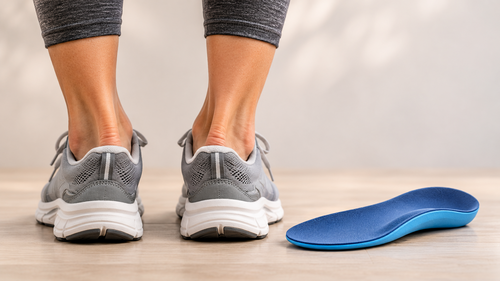

If you've been told you need insoles for overpronation, you may be wondering what that actually means — and whether it's something to worry about. It's not. Overpronation simply means your foot rolls too far inward after your heel strikes the ground, putting extra strain on your arch, ankle, and surrounding muscles. It's a common movement pattern, not a medical crisis. This article explains what overpronation actually is, how it differs from flat feet, what supportive insoles can realistically do (and what they can't), and when it makes sense to get a professional opinion.
What overpronation actually means
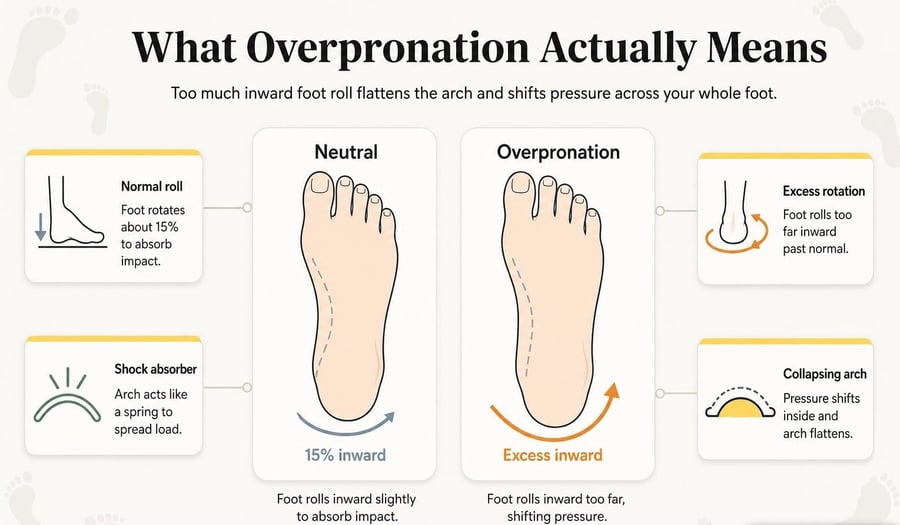
Every step you take involves some inward rolling of the foot — that's normal and necessary. As your heel strikes the ground, your foot naturally rotates inward roughly 15% to spread the impact load and act as a shock absorber. Overpronation is what happens when that inward roll goes further than it should, putting extra stress and strain on the arches and causing the foot to flatten more than it's built to handle. According to the Cleveland Clinic, this excessive inward rotation is the defining feature of overpronation — not just a little extra movement, but enough to shift how force travels through your entire foot.
The mechanics matter here. When the foot rolls too far inward past that normal threshold, it pushes excess pressure to the inside of the foot and creates instability through the ankle and lower leg. The arch, which is meant to be a spring, starts functioning more like a collapsing bridge.
Flat feet and overpronation aren't the same thing
This is a genuinely common source of confusion. Flat feet describe the structure of your foot — specifically, how much arch height you have. Overpronation describes movement — what your foot does during a stride. These two things often show up together, but they don't have to. You can have a low arch and pronate normally, or you can have a reasonably visible arch and still overpronate when walking or running. Treating them as interchangeable leads to wrong assumptions about who's affected and what kind of support actually helps.
Not everyone who overpronates develops pain
Overpronation exists on a spectrum. Some people overpronate noticeably and never experience any discomfort. Symptoms tend to surface when overpronation is more severe, when activity level is high, or when footwear provides little structure to compensate. The foot is adaptable — but those adaptations have limits, and where your personal limit sits depends on a mix of factors that vary from person to person.
Signs you might overpronate
Overpronation doesn't always cause pain — but when it does, the discomfort rarely stays in one place. Because the foot is the foundation for everything above it, an inward collapse at the arch can send problems up the entire kinetic chain. The inward roll rotates the shinbone slightly inward as well, which shifts forces at the knee and hip away from their neutral alignment. Over time, that altered loading pattern can contribute to:
- Plantar fasciitis (inflammation of the thick band of tissue running along the bottom of the foot)
- Achilles tendon pain, since the tendon is pulled at an angle rather than straight
- Shin splints, from increased stress on the muscles and connective tissue along the tibia
- Bunions, driven partly by repeated pressure on the inside of the forefoot
- Knee pain, particularly along the inner side, as the leg tracks inward with each step
Two rough at-home checks
The shoe wear test is the simplest starting point. Flip over a pair of shoes you've worn regularly and look at the sole. Heavier wear concentrated along the inner heel and inner ball of the foot suggests your foot is rolling inward more than it should.
The wet foot test gives you a rough picture of your arch. Wet the bottom of your foot, step onto a piece of cardboard or a paper bag, and look at the shape left behind. A near-complete footprint with little to no inward curve on the arch side is associated with low arches and overpronation.
Both tests are worth trying, but treat them as rough guides rather than verdicts. Self-assessment has real limitations compared to professional gait analysis, which can capture what your eyes can't from a static print or a worn-out sole.
The clinical standard
Podiatrists and physical therapists often use the navicular drop test to quantify how much the arch flattens when you shift from sitting to standing. According to Medical News Today, clinicians mark the navicular bone (a small bone on the inner side of the midfoot) in both positions and measure the difference. A drop of roughly 5 to 9 millimeters is generally considered typical, while a drop of 10 millimeters or more is widely cited as excessive pronation, and values of 15 millimeters or more suggest significantly altered arch mechanics. This isn't a test to perform on yourself — it requires a trained eye and consistent measurement technique to be meaningful.
What insoles can and can't do
Not all insoles are built for the same job. A soft foam cushion adds comfort underfoot, but cushioning and motion control are fundamentally different things. To reduce excessive inward rolling, an insole needs structural components that actually resist movement — specifically, firm arch support, a deep heel cup (which limits rearfoot eversion, the technical term for how much your heel tilts inward), and a semi-rigid to rigid shell that holds its shape when your full body weight presses down on it. Soft foam compresses under load and offers little mechanical resistance to the inward collapse that characterizes overpronation.
Matching the insole to the degree of overpronation
Severity matters more than most people realize. If your overpronation is mild — maybe you notice inner heel wear on your shoes but have no significant pain — a cushioned arch support may be enough to redistribute pressure and reduce fatigue. Moderate-to-severe overpronation is a different situation. Here, you typically need a semi-rigid medial post (extra reinforcement along the inner side of the insole) combined with a deep heel cup that stabilizes the rearfoot before that inward roll can progress up the kinetic chain to your ankle, shin, and knee.
OTC vs. custom orthotics
Custom orthotics — devices made from a mold of your specific foot — are often assumed to be significantly more effective than prefabricated (off-the-shelf) options. The evidence is more nuanced than that. A systematic review published in the Journal of Foot and Ankle Research found moderate-quality evidence that foot orthoses reduce plantar heel pain in the medium term, with no significant difference between prefabricated and custom orthotics at any measured time point. The Cleveland Clinic reflects this in its guidance: OTC devices are a reasonable first step for mild symptoms, with custom orthotics indicated if those symptoms persist or worsen.
That doesn't mean custom orthotics are never worth pursuing. For moderate-to-severe overpronation, complex structural issues, or cases where OTC options have already failed, a podiatrist-fitted device may provide a better mechanical fit. But for many people with mild-to-moderate overpronation, a well-constructed prefabricated insole is a practical and evidence-supported starting point. If you're considering an off-the-shelf option, compare the best shoe insoles offers a starting point for comparison. Keep the distinction between cushioning and structural support in mind as you narrow your choices.
What insoles genuinely cannot do
This is worth being direct about: insoles do not permanently fix overpronation. Their effect is mechanical and largely present only while worn. Remove the insole, and your foot's movement pattern returns to its baseline. They don't rebuild your arch or retrain your gait on their own.
Activity context also shapes what you need structurally. Running places high repetitive impact loads and demands dynamic stability; a running insole typically needs a more rigid shell and pronounced medial post. Work or standing insoles prioritize pressure distribution over long hours. Everyday casual insoles sit somewhere in between. Using a running-specific insole for all-day standing, or vice versa, often means you're getting the wrong kind of support for your actual movement demands.
Insoles work better alongside these habits
Insoles do a lot of the mechanical work, but they function best when your muscles are also pulling their weight. Strengthening the muscles that support your arch — specifically the foot intrinsic muscles (the small muscles inside the foot itself that control toe and arch movement), along with your calves, hips, and core — helps stabilize the foot from the inside out. A 2020 study found that therapeutic foot-strengthening exercises were effective at improving foot posture in adults. That's meaningful, but the key word is "alongside": exercise addresses muscle weakness and coordination, while insoles handle the structural support your foot needs in the meantime.
Calf flexibility deserves a specific mention. Tight calves limit ankle mobility, which forces your foot to compensate by rolling inward more — essentially making overpronation worse. Regular calf stretching, ideally after a brief warm-up or later in the day when the muscle isn't cold, can take some of that pressure off. Certain conditions like plantar fasciitis are often associated with the same biomechanical issues as overpronation, and addressing one often means addressing both.
A simple starting set of exercises might include:
- Towel scrunches or toe spreads to activate foot intrinsic muscles
- Single-leg calf raises for lower-leg strength
- Clamshells or lateral band walks to strengthen hip stabilizers
- Standing calf stretches held for 30 seconds per side, repeated 2 to 4 times
That said, self-managing with insoles and stretching has limits. If you're dealing with persistent or worsening pain, symptoms that don't improve after a few weeks with OTC insoles, or severe overpronation, a podiatrist or physical therapist can assess your gait properly and recommend a more targeted treatment plan.
Frequently asked questions
Can overpronation cause knee, hip, or back pain?
It can, yes. When the foot collapses inward excessively, it rotates the shinbone along with it — and that rotation doesn't stay in the lower leg. Forces travel up what's called the kinetic chain, the linked system of joints and muscles from foot to knee to hip to spine, potentially altering how load is distributed at each point. Not everyone with overpronation develops pain higher up, but it's a recognized contributing factor.
How long do insoles for overpronation typically last?
There's no universal answer, since lifespan depends on your body weight, activity level, and the insole's materials. That said, semi-rigid and rigid-shell insoles generally hold their supportive structure longer than all-foam versions, which compress and lose their corrective function faster. For active daily use, replacing insoles roughly every six to twelve months is a reasonable rule of thumb — the clearer signal is when the support starts to feel degraded or the insole looks visibly compressed.
Is overpronation something children grow out of?
Flexible flat feet — and the inward rolling that comes with them — are genuinely common in young children and do often resolve on their own as the arch develops. But "often" isn't "always," and the right person to assess that for a specific child is a pediatric podiatrist, not a general article. Self-managing a child's gait concerns with over-the-counter insoles without professional input isn't a great idea.
Do motion-control shoes eliminate the need for insoles?
Motion-control shoes — footwear engineered with stiffer midsoles and reinforced medial (inner) sides to limit inward rolling — do provide meaningful built-in support. For mild overpronation, that may be enough. For moderate-to-severe cases, though, they generally aren't a substitute for a fitted orthotic, which delivers more targeted arch support and heel control than shoe construction alone can provide.
Final thoughts
Overpronation is common, and for most people it's manageable — the right insole can meaningfully reduce strain on your arch, ankle, and surrounding muscles. Just keep in mind that insoles are a mechanical aid: they work while you're wearing them, not as a permanent structural fix.
For mild symptoms, starting with an over-the-counter insole with firm arch support and a deep heel cup is a reasonable first step, according to Cleveland Clinic. If pain persists, worsens, or was severe to begin with, a podiatrist or physical therapist can assess your gait properly and determine whether custom orthotics or other treatment make sense for your situation.
Our Methodology: BuyersReport evaluates shoe insoles using material quality, support features, comfort levels, durability, customer feedback, and editorial review. We focus on helping readers compare cushioning, arch support, fit, odor control, and overall value.