
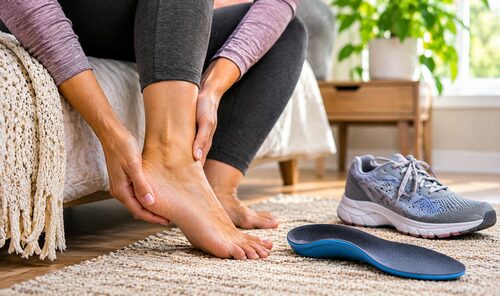

Plantar fasciitis insoles are one of the most searched remedies for heel pain — and there's real evidence they can help. If you're waking up with a sharp, stabbing sensation in your heel that eases after a few minutes of walking, you may be dealing with plantar fasciitis: inflammation of the plantar fascia, the thick band of tissue that runs from your heel to the base of your toes. Firm arch support and a deep heel cup can reduce the strain on that tissue and redistribute pressure across your foot. But insoles work best alongside stretching and other conservative care — not as a standalone fix.
What plantar fasciitis actually is
The plantar fascia is a thick band of connective tissue that runs along the bottom of your foot, connecting your heel bone to the base of your toes. Its job is to absorb shock and support your arch with every step. When that tissue becomes inflamed — typically from repeated stress — the result is plantar fasciitis, the most common cause of heel pain.
That familiar stabbing pain when you first get out of bed in the morning happens for a specific mechanical reason. While you sleep, the plantar fascia rests in a shortened position. The moment you stand up and put weight on your foot, that tight tissue is suddenly loaded and stretched, which is when it hurts most. The pain often eases after a few minutes of walking as the fascia loosens up, then can return after long periods on your feet.
This isn't a rare or minor condition. Plantar fasciitis accounts for approximately one million physician visits per year in the United States. A cross-sectional study using NHANES data found that 11.1% of U.S. adults reported plantar heel pain, with the highest prevalence — 14.5% — in those between the ages of 50 and 65. According to the National Center for Complementary and Integrative Health, females were 2.5 times more likely to report the condition than males, and those with a BMI of 30 or higher were approximately 5 times more likely to have it than those with a BMI under 25.
Mayo Clinic identifies several risk factors that increase your odds of developing the condition:
- Obesity
- High-impact activities like running
- Flat feet or high arches
- A tight Achilles tendon
- Wearing shoes with minimal support, especially on hard surfaces
Having one risk factor doesn't guarantee you'll develop plantar fasciitis, and plenty of people with multiple risk factors never do. But understanding where the condition comes from is a useful starting point for thinking about how to manage it.
How insoles help — and what the evidence says
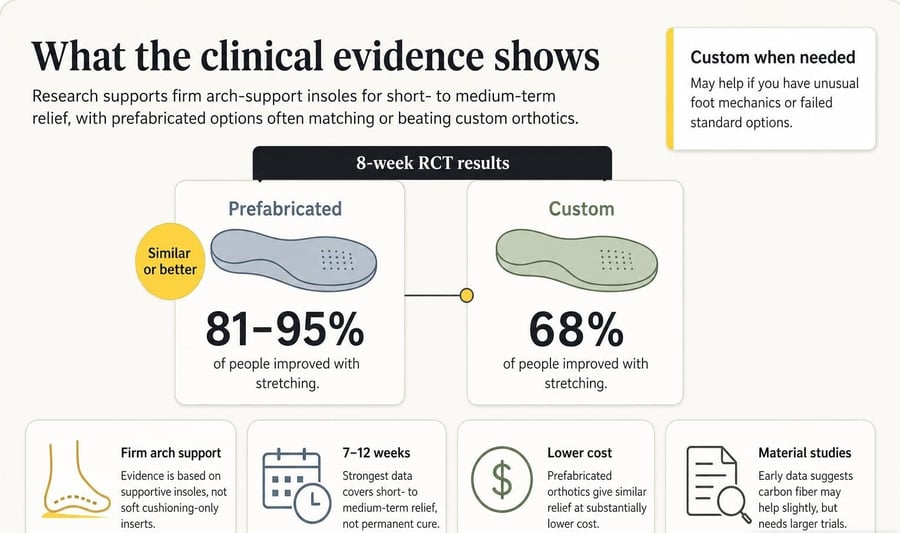
Arch support works by limiting how far the plantar fascia stretches with each step. Under your body weight, that band wants to elongate. A firm arch support props up the midfoot so the fascia doesn't have to stretch as far, reducing the cumulative strain that causes inflammation over thousands of steps a day.
A deep heel cup adds something different. It cradles the natural fat pad under your heel and spreads impact across a wider surface area rather than letting pressure concentrate on one point. The two features work together, which is part of why full-contact insoles — designs that support the entire sole from heel to forefoot — outperform heel cups used alone. Research cited in a PMC-indexed study by Ribeiro et al. specifically notes this finding: heel cups in isolation don't deliver the same pain relief as insoles that maintain contact with the full foot.
What the clinical evidence actually shows
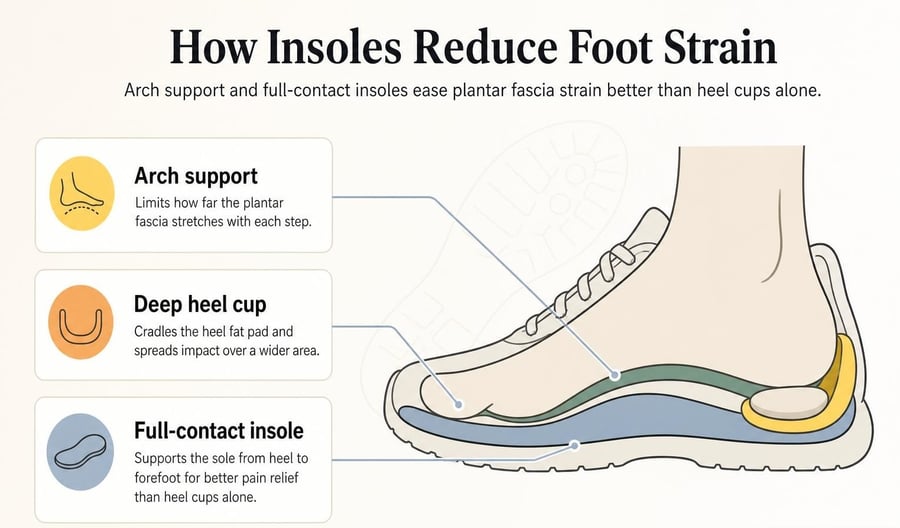
The evidence for insoles is reasonably solid, particularly for the short-to-medium term. Mayo Clinic lists arch supports — store-bought or custom-made — as a recognized treatment option, noting they "can help distribute pressure more evenly across your feet."
One of the most cited studies in this space is an RCT by Pfeffer et al., which enrolled 236 patients across 15 centers. Prefabricated shoe inserts combined with stretching produced improvement rates of 81–95% at eight weeks, depending on insert type. Custom polypropylene orthotics combined with stretching produced a 68% improvement rate over the same period. That's a meaningful gap — and it favors the over-the-counter option. A PMC-published review reinforces this pattern, finding that prefabricated and custom-fitted orthotics both reduce pain and improve function in adults with acute plantar fasciitis, with few risks, and that prefabricated orthotics provide similar relief at substantially lower cost.
Custom orthotics aren't useless — they may be appropriate if you have unusual foot mechanics or haven't responded to standard options — but the evidence doesn't position them as automatically superior for most people.
There are honest limits to what this research shows. The strongest clinical support covers roughly the seven-to-twelve-week window. Insoles appear to help people get through the acute phase of pain; there's less evidence they produce indefinite, long-term cure on their own.
One other distinction worth making: soft, cushioning-only insoles aren't the same thing as arch-support insoles. Cushioning may feel comfortable, but it doesn't address the mechanical load problem. The evidence base is built on insoles with firm arch support — that's the feature doing the biomechanical work.
A 2024 RCT comparing foam, polyurethane, and carbon fiber prefabricated insoles found carbon fiber options showed slightly better pain relief at six weeks and quality-of-life improvements at twelve weeks. That finding is worth noting, but the study acknowledged a possible industry funding link and called for larger future research before drawing firm conclusions.
Insoles work better as part of a plan
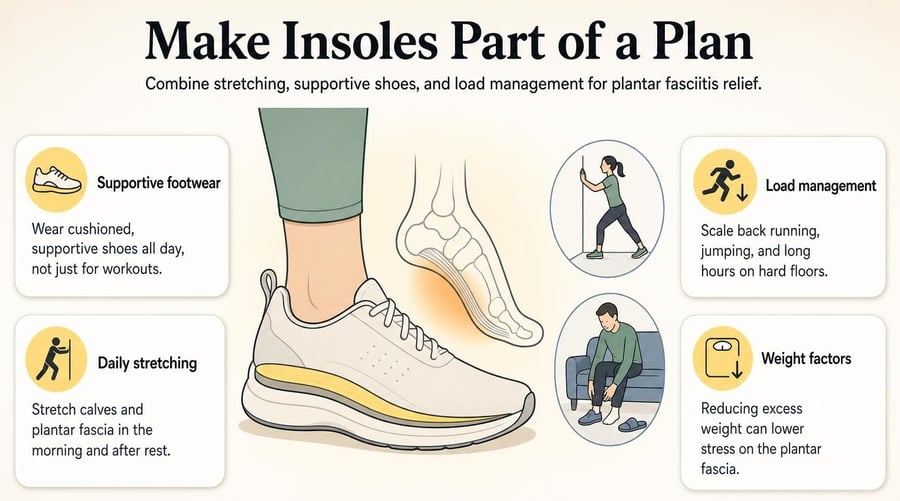
Insoles reduce the mechanical load on your plantar fascia, but they can't loosen a tight calf muscle or release tension that has built up in the fascia itself. That's why stretching isn't optional — it's the part of treatment that addresses the underlying tightness insoles can't reach. Calf stretches and plantar fascia-specific stretches work on the tissue directly; insoles manage the forces acting on it. You need both.
A typical conservative plan pulls together several elements:
- Supportive footwear worn consistently — not just during runs or workouts, but throughout the day
- Calf and plantar fascia stretching — ideally performed in the morning before you take your first steps, and again after periods of rest
- Activity modification — scaling back high-impact loading (running, jumping, prolonged standing on hard floors) while the fascia recovers
- Weight management where relevant — reducing load on the foot matters, since excess body weight is a recognized risk factor for the condition
That second bullet points to something many people miss. A lot of plantar fasciitis sufferers are careful about their footwear during exercise, then immediately kick off their shoes and walk barefoot on hardwood or tile at home. Every unloaded step on a hard floor re-strains the fascia. The supportive benefit you built during the day is essentially reset. Wearing supportive shoes or slippers consistently — including during those short trips to the kitchen — matters more than most people realize.
The encouraging part: Mayo Clinic advises that most people with plantar fasciitis recover within a few months using simple treatments that don't involve surgery — including icing the heel, stretching, and avoiding activities that cause pain — and that surgery is rarely needed, considered only when pain is serious and other treatments haven't helped. For most people, consistent attention to footwear, stretching, and load management is enough.
That said, insoles and home care have limits. If your pain is severe, it's disrupting daily activities, or it hasn't improved after several weeks of conservative effort, that's the point to see a doctor. A physician can rule out other causes of heel pain and discuss whether additional interventions — physical therapy, corticosteroid injections, imaging — are warranted.
Frequently asked questions
Should I wear insoles all the time if I have plantar fasciitis?
Consistency matters more than you might expect. Wearing supportive insoles throughout the day — including at home — tends to produce better results than only putting them in for workouts or long walks. The plantar fascia is under load any time you're on your feet, so switching to unsupportive slippers or going barefoot at home can undercut the relief you're getting from insoles during the day.
How long does it take for insoles to relieve plantar fasciitis pain?
Most clinical studies measure outcomes somewhere in the 6–12 week range, and that's roughly when consistent users tend to see meaningful improvement. The Pfeffer et al. RCT published in Foot & Ankle International found notable improvement rates at 8 weeks with prefabricated inserts combined with stretching. That said, individual results vary depending on how long you've had the condition, how consistently you use the insoles, and whether you're doing complementary things like stretching.
Are custom orthotics better than over-the-counter insoles for plantar fasciitis?
For most typical cases, the evidence doesn't favor custom. A PMC-indexed review of orthotics for plantar fasciitis found that prefabricated insoles provide similar pain relief and functional improvement to custom devices at substantially lower cost. The Pfeffer RCT actually found prefabricated inserts outperformed custom orthotics at 8 weeks. Custom may be worth considering if your foot structure is unusual or if over-the-counter options haven't helped after a reasonable trial period.
When should I see a doctor instead of trying insoles on my own?
If your pain is severe, significantly limiting daily activity, or hasn't improved after several weeks of consistent conservative care — insoles, stretching, supportive footwear — a clinician can rule out other causes of heel pain and discuss additional options. Heel pain doesn't always mean plantar fasciitis, and a professional evaluation helps ensure you're treating the right problem.
Final thoughts
The clinical evidence behind plantar fasciitis insoles is real. Firm arch support and a deep heel cup have demonstrated genuine pain-relieving benefits across multiple studies — these aren't marketing claims. And for most people, an over-the-counter option does the job as well as an expensive custom device, at a fraction of the cost.
That said, insoles work best when they're part of a consistent routine: wearing them daily, keeping up with calf and plantar fascia stretches, and not going barefoot at home on hard floors. The evidence points to combination care, not any single product, as what actually drives recovery.
If you're ready to explore options, comparing insoles by arch height, heel cup depth, and material is a reasonable starting point. For a starting shortlist, see the top shoe insoles for arch support, then weigh each option against those features. If self-management hasn't moved the needle after a few weeks, a podiatrist can help narrow down what's holding you back.
Disclaimer: The information in this article is general and educational in nature. It is not a substitute for professional medical advice, diagnosis, or treatment. If you are experiencing heel pain or think you may have plantar fasciitis, consult a qualified healthcare provider — such as a podiatrist or orthopedic specialist — for guidance specific to your situation.
Our Methodology: BuyersReport evaluates shoe insoles using material quality, support features, comfort levels, durability, customer feedback, and editorial review. We focus on helping readers compare cushioning, arch support, fit, odor control, and overall value.