
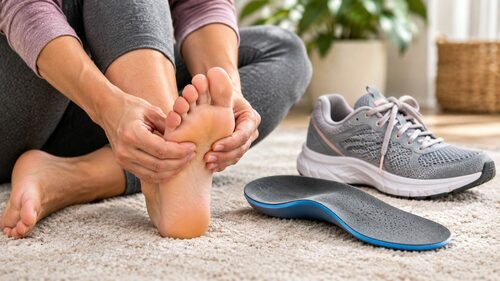

Ball-of-foot pain has a clinical name — metatarsalgia — and it's more common and more treatable than most people assume. The aching or burning sensation you feel under your forefoot is centered around the metatarsal heads, the small bones that sit just behind your toes. Here's something worth knowing upfront: metatarsalgia is a symptom, not a standalone condition. That distinction matters because the right fix — whether that's an insole, a footwear change, or something else entirely — depends on what's actually causing the pressure and inflammation. This article walks through the most common culprits and explains what insoles can and can't do about them.
What actually causes ball-of-foot pain
Metatarsalgia is pain and inflammation in the ball of the foot — specifically, the area between the arch and the toes — centered under one or more of the five metatarsal heads, the knobby ends of the long foot bones that sit just behind your toes. That distinction matters because metatarsalgia is a symptom of underlying problems, not a disease in itself. Treating the pain without identifying what's driving it tends to produce limited results.
The three clinical categories of causes
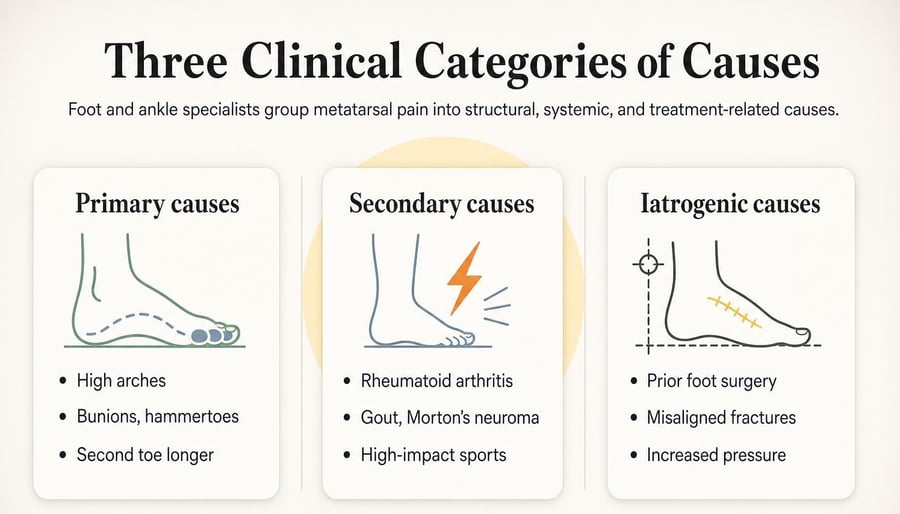
Foot and ankle surgeons sort causes into three buckets, and according to the Cleveland Clinic, more than one is often at play at the same time.
Primary causes are structural — built-in features of your foot anatomy. High arches concentrate pressure on the metatarsal heads rather than distributing it across the foot. Bunions, hammertoes, and having a second toe longer than your big toe all alter the mechanics of how your foot loads with each step.
Secondary causes are systemic conditions or activity-related factors. These include rheumatoid arthritis, gout, Morton's neuroma (a thickening of tissue around a nerve between the toes, usually between the third and fourth metatarsal heads), stress fractures, and high-impact sports that repeatedly pound the forefoot.
Iatrogenic causes — meaning harm that results from medical treatment — come from prior foot surgery or fractures that didn't heal in proper alignment, leaving the metatarsals in a position that increases pressure.
Everyday contributors most people recognize
Footwear is one of the most direct levers. Per Mayo Clinic, high heels put extra weight on the front of the foot, while shoes with a narrow toe box or athletic shoes without enough support and padding compound the problem. Switching shoes often makes an immediate difference.
Excess body weight matters too. Most of the body's weight transfers through the forefoot during movement, so extra pounds raise the pressure on those metatarsal heads. Mayo Clinic notes that losing weight may reduce or resolve symptoms in people who are overweight.
Aging introduces a less obvious but significant factor: fat pad atrophy. The natural cushioning pad under the ball of the foot thins over time, reducing shock absorption and making the metatarsal heads more vulnerable to repetitive micro-trauma and inflammation. This is worth calling out specifically because it changes what kind of support actually helps — an older adult dealing with fat pad atrophy often needs softer cushioning more than rigid arch support.
Symptoms — and conditions that look like metatarsalgia
The pain most people describe follows a recognizable pattern: a burning, aching, or sharp sensation centered in the ball of the foot — that padded area just behind your toes — that gets noticeably worse when you stand, walk, or run. Many people also notice numbness or tingling in their toes, and a surprisingly common complaint is the feeling that there's a pebble stuck in your shoe, even when there isn't. Cleveland Clinic describes this cluster of sensations as the hallmark presentation of metatarsalgia.
One thing that often sets metatarsalgia apart from an acute injury: the pain usually builds gradually over weeks or months rather than appearing after a single incident. If you're suddenly limping after a misstep, something else may be going on.
When it's not metatarsalgia
Here's the clinical wrinkle that matters for treatment — several other conditions affect the same part of the foot and produce nearly identical symptoms:
- Morton's neuroma — a thickening of nerve tissue between the metatarsal bones, often producing burning or the sensation of standing on a rolled-up sock
- Sesamoiditis — inflammation of the two small sesamoid bones beneath the first metatarsal head, common in dancers and runners
- Stress fractures — tiny cracks in a metatarsal bone, usually from repetitive loading, that can feel like a persistent stone bruise
- Capsulitis — inflammation of the ligament capsule surrounding a metatarsal joint, most often the second toe
- Intermetatarsal bursitis — irritation of the fluid-filled bursae (small cushioning sacs) between the metatarsal bones
- Plantar plate injury — a tear or strain in the fibrous ligament that stabilizes the base of a toe, frequently mistaken for general forefoot pain
According to Mayo Clinic, distinguishing between these conditions before starting treatment is genuinely important — an X-ray or other imaging may be needed to identify or rule out a stress fracture or related problem. A metatarsal pad repositions pressure away from the metatarsal heads and can work well for true metatarsalgia — but it won't stabilize a plantar plate tear, and it certainly won't allow a stress fracture to heal. Some of these conditions require imaging, offloading devices, or specific physical therapy that a cushioned insole simply can't replicate.
How insoles and metatarsal pads actually help
Insoles don't cure metatarsalgia, but the right ones can meaningfully reduce the pressure driving your symptoms — and understanding the mechanics helps you choose more wisely.
How pressure redistribution actually works
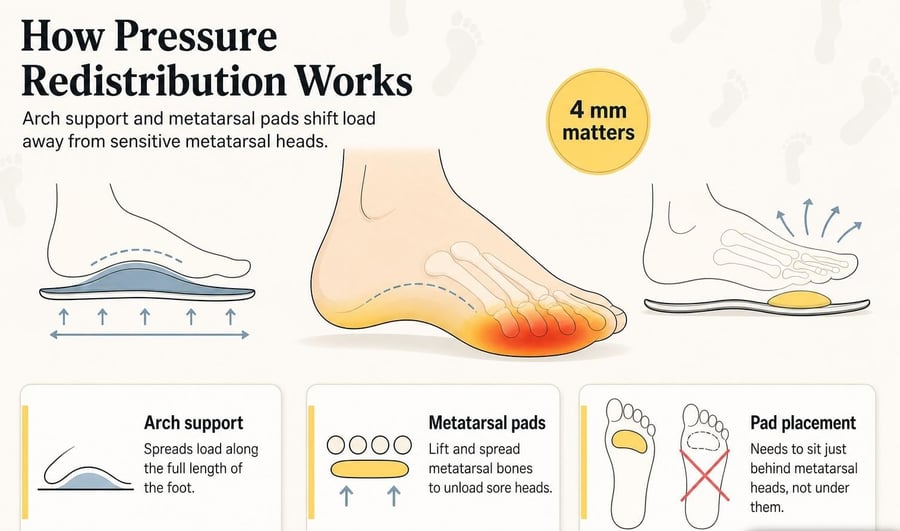
The core problem in most ball-of-foot pain is that too much load is concentrating under the metatarsal heads. Insoles address this in two main ways: arch support and metatarsal pads.
Arch support works by improving weight distribution along the full length of the foot. When your arch is properly supported, the forefoot doesn't have to absorb as much load with each step. Metatarsal pads take a more targeted approach — they lift and spread the metatarsal bones to redirect pressure away from the sensitive heads. The catch is that placement is everything.
A metatarsal pad needs to sit proximal to (just behind) the metatarsal heads, not directly underneath them. Placing a pad directly under the sore area feels intuitive but actually increases pressure right where you don't want it. Research cited in Lower Extremity Review Magazine found that positional differences as small as 4 mm can influence a pad's ability to reduce peak plantar pressure — meaning a slightly wrong placement can reduce or eliminate the benefit entirely.
Cushioning and fat pad atrophy
For older adults, the equation shifts. The natural fat pad under the ball of the foot thins with age, reducing the foot's built-in shock absorption. For this group, softer cushioning materials often matter more than firmer arch support. That's a meaningfully different insole profile than what a younger athlete with high arches and heavy forefoot loading might need. If you're also dealing with plantar fasciitis and arch support concerns, your insole strategy may need to address multiple foot issues at once.
OTC insoles versus custom orthotics
Over-the-counter (OTC) prefabricated insoles — the kind you buy off a shelf — suit many mild to moderate cases and are a reasonable first step. Custom orthotics are made from an individual mold of your foot by a podiatrist and are shaped specifically to your mechanics. They cost considerably more, but the tradeoff can be worth it: Lower Extremity Review cited a clinical study in which custom orthotics produced significantly lower pain scores than prefabricated alternatives. Custom orthotics are generally worth considering when OTC options haven't provided adequate relief.
Mayo Clinic notes that shock-absorbing insoles or arch supports "might prevent or lessen future problems with metatarsalgia" — framing insoles as both a treatment and a preventive measure.
Matching features to cause
There is no single best insole for ball-of-foot pain. Someone with rheumatoid arthritis affecting the forefoot joints has different mechanical needs than someone with a high-arched foot that's overloading the second metatarsal. The features that help most depend directly on what's causing the pressure in the first place — which is why knowing your underlying cause isn't just useful background information, it's the starting point for choosing the right support. To compare off-the-shelf options with those needs in mind, see our guide to the best shoe insoles. Use it as a starting shortlist, then check each option for the cushioning and support features that match your situation.
Frequently asked questions
Can ball-of-foot pain go away on its own?
Mild cases often do resolve with rest, activity modification, and switching to better-fitting footwear. If your symptoms are minor and you can identify an obvious cause — a recent increase in activity, a pair of unsupportive shoes — giving it time and making those adjustments is a reasonable first step. Pain that hasn't improved after about two weeks of home treatment, though, is worth getting checked out.
When should you see a doctor about ball-of-foot pain?
Cleveland Clinic guidance recommends seeking medical advice if your pain hasn't improved after roughly two weeks of self-care. Beyond that threshold, there are a few other situations that call for a professional evaluation sooner:
- Pain is worsening or keeps coming back after resolving
- It's stopping you from normal daily activities or exercise
- You're also experiencing tingling or numbness in your toes
- You have diabetes, since foot problems carry greater risk in that context
Is metatarsalgia the same as plantar fasciitis?
No — they're distinct conditions affecting different parts of the foot. Plantar fasciitis is inflammation of the plantar fascia, the band of tissue running along the bottom of the foot, and its pain is typically centered near the heel. Metatarsalgia is pain in the forefoot, specifically under the metatarsal heads (the bony area just behind the toes). Different location, different underlying cause, and often different treatment approaches.
Where exactly does a metatarsal pad go in the shoe?
The placement is counterintuitive: a metatarsal pad should sit just behind the ball of the foot, not directly under the painful area. The goal is to lift and spread the metatarsal bones so pressure is redistributed away from the metatarsal heads. Placing the pad too far forward — right on the sore spot — can actually increase pressure where you least want it. Research covered in Lower Extremity Review Magazine found that placement differences as small as 4 mm can affect how well a pad reduces peak pressure underfoot.
Final thoughts
For most people, ball-of-foot pain responds well to conservative steps — rest, smarter footwear choices, and insoles with the right features for what's actually driving the discomfort. The key is that last part. Because metatarsalgia is a symptom rather than a root cause, reaching for any insole without understanding what's behind the pain is a bit like treating a headache without asking why it's there.
Disclaimer: This article is general informational content only and is not a substitute for professional medical advice, diagnosis, or treatment. If your ball-of-foot pain is persistent, worsening, or unclear in its cause, consult a podiatrist or qualified healthcare provider before starting any treatment.
Our Methodology: BuyersReport evaluates shoe insoles using material quality, support features, comfort levels, durability, customer feedback, and editorial review. We focus on helping readers compare cushioning, arch support, fit, odor control, and overall value.