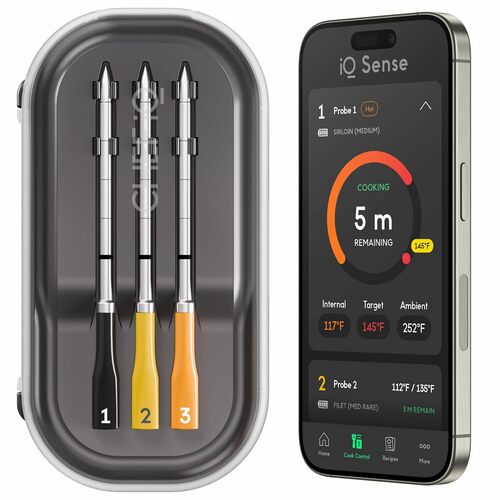
Guessing whether your chicken is done or pulling a steak by feel might feel intuitive, but it's also how meals end up overcooked, undercooked, or — worse — unsafe to eat. A meat thermometer takes the guesswork out of the equation, giving you a precise internal temperature reading so you can hit doneness targets with confidence and cook to USDA-recommended safe internal temperatures, the benchmark that makes thermometer precision matter in the first place. Whether you're checking a weeknight roast, managing a multi-hour smoke session, or grilling for a crowd, the right thermometer for your cooking style can make a meaningful difference in both results and peace of mind. This guide walks you through the key types, specs, and features to evaluate so you can find the model that fits how you actually cook. Results and performance can vary by model, probe type, and cooking environment, so treat the guidance below as a framework rather than a one-size-fits-all answer.
Who Should Buy a Meat Thermometer?
A meat thermometer is useful for virtually any home cook, but the type you need depends heavily on how and where you cook. If you're still relying on color, juice color, or the poke test to judge doneness, a thermometer should be your next kitchen purchase — those methods are notoriously inconsistent. Here's how to identify which use case fits you:
- Quick weeknight cooks: If you're mostly checking chicken breasts, pork chops, or burgers on a weeknight, a simple instant-read model handles everything you need without added complexity.
- Backyard grillers: Outdoor grilling — especially over charcoal — benefits from fast, accurate spot checks, and a ruggedized, weather-resistant thermometer is a practical consideration.
- Low-and-slow smokers: Long, unattended cooks like brisket or pork shoulder benefit from continuous temperature monitoring, which makes a leave-in probe or wireless smart probe especially valuable.
- Beginner cooks: If food safety is a primary concern, a straightforward digital instant-read takes much of the uncertainty out of judging whether proteins have reached a safe internal temperature. A thermometer is a tool that supports safe cooking — it doesn't replace proper handling, storage, and hygiene practices.
- Multi-protein cooks: Cooking a full holiday spread or different cuts simultaneously means a multi-probe setup pays for itself in fewer trips to the oven and more consistent results across every dish.
Types of Meat Thermometers
The market breaks down into five main styles, each suited to a different cooking scenario. Understanding what each type does — and where it falls short — is the most important step in picking the right one.
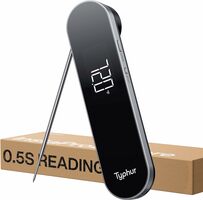
- Instant-read digital: The most popular all-around option, these give you a fast temperature reading when you insert the probe into meat. They're designed for spot checks rather than continuous monitoring, and they're the go-to for most everyday cooks.
- Leave-in wired probe: A probe stays in the meat throughout cooking, with a cable running to a base unit outside the oven or grill. This gives you continuous monitoring without opening the oven repeatedly — ideal for roasts and slow-cooked cuts.
- Wireless/Bluetooth smart probe: A fully wireless probe sits inside the meat (or the grill) and transmits data to your phone via Bluetooth or Wi-Fi. These offer the most freedom of movement but introduce app dependency and potential connectivity considerations.
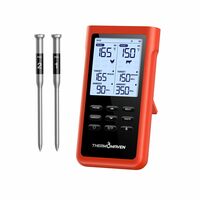
- Multi-probe thermometer: Two or more probes connect to a single display or hub, letting you track different cuts or grill zones simultaneously. Especially useful for smokers and large-format cooks where different proteins finish at different times.
- Analog dial: Traditional and battery-free, dial thermometers are simple and durable but generally read more slowly and can be harder to read precisely than digital models. They still have a place as a backup or for general checks where speed and fine precision aren't critical.
Accuracy and Response Time: The Specs That Matter Most
Accuracy is the single most important performance attribute — an unreliable reading defeats the purpose of the tool. The USDA sets specific safe internal temperature guidelines for every protein (165°F for poultry, 145°F for whole cuts of pork and beef, 160°F for ground meat), and a thermometer that's off by even a few degrees can mean the difference between a properly cooked meal and a food safety concern. Response time matters too: a slow thermometer becomes genuinely frustrating when you're checking multiple spots on a grill or working outdoors in cold weather.
- Accuracy (±°F deviation): Most quality digital instant-reads fall within ±1–2°F of the true temperature. The tighter this number, the more reliable your doneness calls — especially near critical safe-temperature thresholds.
- Response time: Measured in seconds to a stable final reading, response time typically ranges from 2–3 seconds on fast digital models to 15–30 seconds or more on analog dials. Response time affects real-world usability, especially when checking multiple spots or cooking outdoors where heat escapes quickly.
- Temperature range: A broader supported range (often −58°F to 572°F or wider on better models) means the thermometer handles everything from candy-making to high-heat searing. Verify the range covers your most extreme cooking use case before buying.
Connectivity: Wired vs. Wireless
For cooks who want to monitor temperature without staying near the grill or oven, connectivity is a major deciding factor. The tradeoff is convenience versus simplicity, and neither approach is universally better — it depends on how you cook and how much you want to manage. Connectivity features like Bluetooth and Wi-Fi add convenience but can introduce complexity and potential signal issues, so it's worth thinking through how much you'll actually rely on them.
- Wired leave-in probes: A physical cable connects the probe to a display unit. No apps, no pairing, no signal drops — just a continuous readout. The limitation is that the cable tethers you somewhat and can be damaged over time by high grill temperatures if not managed carefully.
- Bluetooth connectivity: Pairs with a smartphone app to deliver temperature alerts and logs. Convenient for backyard use, but Bluetooth range varies meaningfully by model and environment — walls, distance, and interference can all affect signal reliability. Check the rated range and recent user feedback rather than assuming consistent performance.
- Wi-Fi connectivity: Extends monitoring range well beyond Bluetooth, letting you track a long smoke from anywhere in your home (or in some cases, remotely). Requires a stable home network connection and app setup, which adds a layer of initial complexity.
- App features worth checking: Preset temperature alerts by protein, cook timers, and temperature graphing are common app features. Evaluate whether these genuinely fit your workflow or whether they're more setup than they're worth for how you cook.
Key Features to Look For
Beyond accuracy and connectivity, several practical features separate a thermometer you'll reach for every cook from one that collects drawer dust. Weighing these against your specific habits will guide you toward the right fit.
- Probe count: A single probe handles the majority of home cooking tasks. If you regularly cook multiple proteins simultaneously — or want to monitor both meat temperature and ambient grill temperature at once — a two- or four-probe setup earns its keep.
- Display readability: A large, backlit display matters when you're reading a thermometer over a hot grill at dusk or in a dark smoker. Check the viewing angle too — some displays are only clearly readable head-on.
- Build quality and waterproofing: Outdoor and grill use means exposure to moisture, grease, and heat. Look for an IP rating (IP65 or higher is a solid benchmark for splash resistance) if you plan to use the thermometer in wet or messy environments.
- Probe length and construction: Longer probes keep your hand further from heat and are better for thick roasts. Stainless steel probes hold up better over time than thinner, less rigid alternatives.
- Ease of use: Auto-rotating displays, magnetic backs, fold-out probes with automatic on/off, and simple button layouts all contribute to a thermometer you'll actually use rather than skip in a rush.
Care and Maintenance
A thermometer is only as accurate as its last calibration check, and a few simple habits keep readings trustworthy over time.
- Calibrate periodically: Test in an ice-water bath (should read 32°F) or boiling water (212°F at sea level) to confirm accuracy. Many digital models include a calibration adjustment; analog dials usually have a small nut beneath the dial face.
- Clean probes properly: Wipe probes with hot soapy water after each use. Most probes and bases are not dishwasher-safe — check the manufacturer's guidance before submerging anything with electronics inside.
- Protect cables and connectors: For wired leave-in probes, avoid pinching cables in oven doors or routing them across direct flame. Frayed or kinked cables are the most common failure point.
- Store thoughtfully: Keep probes in a protective sleeve or case to prevent tip damage, which is the part of the probe that drives accuracy and response time.
Bottom Line
The best meat thermometer is the one that matches how you actually cook — not the one with the most features. If you're doing quick weeknight checks, a fast and accurate instant-read digital is all you need. If you're managing long smoke sessions or juggling multiple proteins, a leave-in or wireless multi-probe setup will give you the continuous monitoring and freedom of movement that changes the experience. Focus first on accuracy and response time, then layer in connectivity and probe count only where they solve a real problem in your cooking. A reliable thermometer won't make every meal perfect on its own, but it removes the guesswork behind most common cooking mistakes — and that alone makes it one of the more valuable tools in any kitchen.

 CHEF iQ
 ThermoMaven
 CHEF iQ
 Typhur
 ThermoMaven