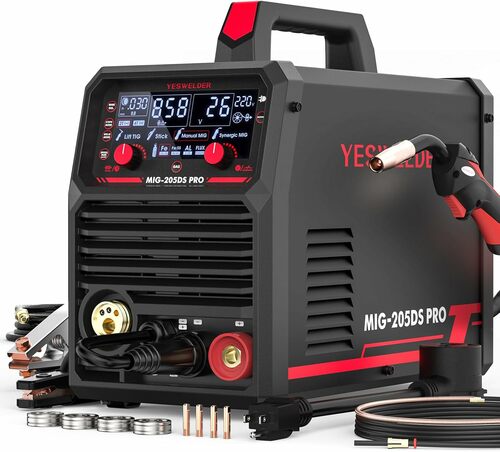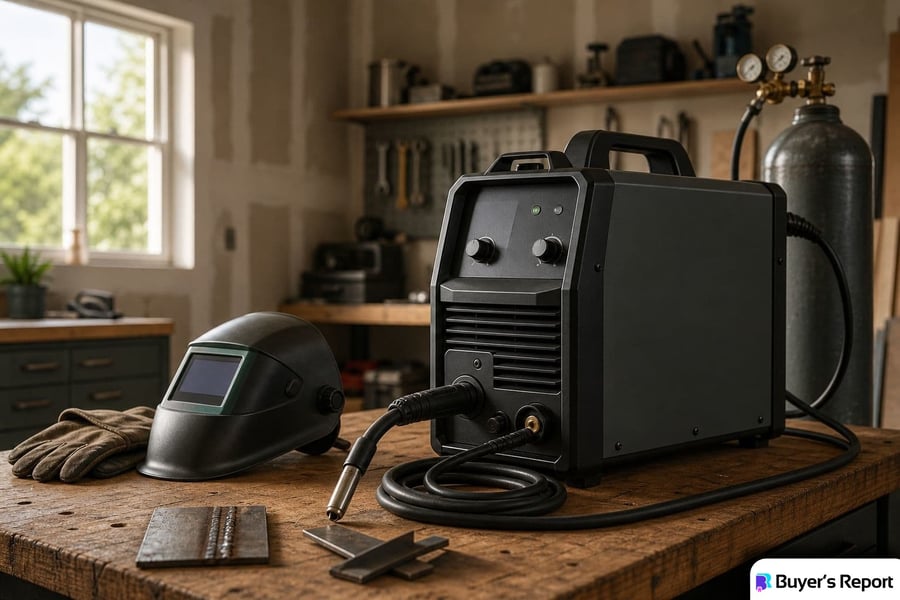
A MIG welder is one of the most versatile tools you can add to a garage, shop, or farm — capable of joining sheet metal, structural steel, and everything in between with speed and consistency that other welding processes can't easily match. But buying the wrong machine is a costly mistake: a welder that's underpowered for your material, incompatible with your electrical supply, or poorly matched to how often you actually weld will create more frustration than it solves. This guide walks you through the specs and variants that matter most — amperage, duty cycle, input voltage, and shielding method — so you can match a machine to your actual projects rather than buying on brand recognition or price alone.
Who Should Buy a MIG Welder?
MIG welding suits a wide range of users precisely because the process is relatively fast to learn and adaptable across material types. That said, the machine that works well for weekend hobbyists looks very different from one built for daily shop production. Consider where you fall before you start comparing specs.
- DIY homeowners and hobbyists tackling occasional repairs, garden furniture, or automotive bodywork will find a 120V machine more than adequate for light-gauge steel and short welding sessions, without the need for a special electrical circuit.
- Automotive restorers working thin sheet metal need precise low-heat control above all else. Look for machines with fine wire-feed adjustment and, ideally, pulse capability to minimize warping on body panels.
- Small-shop fabricators and tradespeople running the machine for hours at a stretch need higher duty cycles and 240V power. Skimping here means constant thermal shutdowns that kill productivity.
- Farmers and ranchers often need portability as much as power — equipment repairs happen in the field, not just in a workshop. Dual-voltage or gasless flux-core setups offer the flexibility to work wherever the job is.
- Vocational students and beginners buying their first machine benefit from synergic or auto-set controls that reduce setup variables while they develop skill. A forgiving arc matters more than maximum amperage at this stage. Anyone new to the process should seek formal training or hands-on instruction before operating welding equipment, and expect that individual results and weld quality will vary based on skill level, material preparation, and machine settings.
MIG welders are general-purpose fabrication tools. They are not appropriate for pressure vessels, structural or load-bearing assemblies, or other safety-critical repairs unless the operator holds the relevant professional welding qualifications and the work is inspected to the applicable code.
Types of MIG Welders
The MIG welder category spans several distinct variants, and the differences between them affect not just price but where and how you can practically use the machine. Understanding these types upfront narrows your shortlist considerably.
- 120V single-phase welders run on a standard household outlet and require no electrical upgrades. They cap out at lower amperage, which limits maximum material thickness, but for light-gauge steel and occasional use they're a practical, affordable entry point.
- 240V welders deliver higher amperage and longer sustained duty cycles, making them the right choice for thicker materials and regular shop use. They require a dedicated 240V circuit — consult a qualified electrician before installing one.
- Dual-voltage welders switch between 120V and 240V, giving you flexibility across locations. They're particularly useful if you work in multiple environments — a home garage on 120V and a commercial shop on 240V, for example.
- Gas-shielded welders use an external cylinder of shielding gas (typically CO₂ or a mixed argon blend) to protect the weld pool. Indoors, this produces cleaner, lower-spatter welds with better appearance and less post-weld cleanup.
- Gasless flux-core welders use self-shielding wire that generates its own protective gas when it burns. No cylinder is needed, which makes setup simpler and outdoor or drafty-environment work more practical. Flux-core is not equivalent to gas-shielded welding across the board — appearance, spatter, slag, and behavior on thin material differ meaningfully, and the right choice depends on the job.
- Synergic and inverter welders use a microprocessor to pre-program arc parameters based on wire type, diameter, and material. They reduce setup errors and are particularly well-suited to beginners or anyone switching frequently between materials.
- Pulse MIG welders alternate electronically between a peak current and a lower background current, reducing overall heat input. This matters most when welding stainless steel or aluminum, where distortion and burn-through are real risks.
- Multi-process welders combine MIG with TIG and Stick capability in one machine. If your work spans multiple processes and budget is a consideration, one well-specified multi-process unit can replace several single-process machines.
Amperage, Duty Cycle, and Voltage — Matching the Numbers to Your Work
These three specifications interact directly, and getting all three right is the single most important part of choosing a MIG welder. A machine that excels on one spec while falling short on another will still disappoint you in practice. Match amperage output and duty cycle to your actual project requirements — oversized and undersized machines both create problems.
- Amperage and material thickness are linked, but the right current depends on the specific material, joint, wire, and shielding gas you're using, so treat any rule of thumb as a starting point rather than a universal setting. As a rough planning guide, many fabricators allow roughly 35–40 amps per millimeter of mild steel thickness; a machine rated to 140A will typically handle mild steel up to about 3–4mm, and thicker stock needs more output. Match the machine's maximum amperage to the thickest metal you'll regularly weld — not the thickest you might conceivably weld one day.
- Duty cycle tells you what percentage of a 10-minute window the machine can weld before it needs to cool down. A 30% duty cycle means 3 minutes of welding followed by 7 minutes of rest. Light hobby use can tolerate a 20–30% rating; regular workshop or production use needs 40% or more at your actual working amperage. Check that the duty cycle figure is quoted at your working amperage, not just at maximum output.
- Input voltage compatibility has to match what your workspace actually provides. A 240V machine is useless if you only have a 120V outlet, and vice versa. Confirm your available circuit before you buy, and factor in the cost of any electrical work needed.
Oversized machines give you poor arc control on thin material; undersized machines overheat and shut down before you finish a run. Neither is a bargain.
Key Features to Look For
Beyond the core specs, the day-to-day usability of a MIG welder comes down to a handful of practical features. These are the things that distinguish a machine that's genuinely easy to work with from one that fights you at every setup.
- Wire feed speed control is the primary variable you'll adjust alongside voltage. Smooth, consistent wire feed at low and high speeds matters more than the number of preset programs. Look for stepless adjustment rather than fixed steps if you work across a range of materials.
- Auto-set or synergic controls calculate wire speed and voltage from a small number of inputs — wire diameter, material type, and thickness. For beginners or anyone who values fast setup, this feature reduces the trial-and-error that wastes material and time.
- Portability and form factor become critical if you'll move the machine between locations. Check the total weight, whether it includes a handle or wheel kit, and whether the gas inlet is compatible with transportable cylinders if you plan to work away from a fixed gas supply.
- Drive roller quality is easy to overlook but affects wire feed consistency throughout a weld. Metal drive rollers outlast plastic ones; look for machines that also accept knurled rollers if you plan to run flux-core wire.
- Torch and cable length determine how much reach you have without repositioning the machine. A longer torch cable is a convenience for larger workpieces; a heavier torch can cause fatigue on extended sessions.
Safety Features and Compliance to Verify Before Buying
MIG welders carry real electrical, thermal, and fire risks. No machine design removes those risks entirely — the protection built into the unit reduces but does not eliminate them, and operator practices matter just as much. Before purchasing, check the spec sheet for the features below and verify that the unit carries appropriate certification for your region.
- Thermal overload protection automatically cuts power if the machine overheats, protecting both the unit and the operator. This should be listed as a standard feature, not an optional extra.
- Voltage and short-circuit protection guard against supply fluctuations and wiring faults that can damage the machine or create shock hazards. Confirm these are included, particularly if you'll be using the welder on a generator or non-dedicated circuit.
- Safety certification marks (CE in Europe, CSA or UL in North America) confirm the machine has been independently tested to electrical safety standards. Avoid uncertified machines regardless of price.
- IP or ingress rating indicates how well the machine is protected against dust and moisture. For shop or outdoor use, a rated enclosure matters; an unrated machine in a dusty environment is a reliability and safety concern.
The machine itself is only half the safety picture. Always wear appropriate personal protective equipment — an auto-darkening welding helmet rated for the process, flame-resistant gloves and clothing, and steel-toed boots — every time you strike an arc; a MIG welder is not safe to operate without PPE or in an unventilated space. Adequate ventilation is required because welding fumes can be hazardous; work outdoors or use mechanical extraction in line with OSHA guidance. Keep all flammable materials clear of the work area to reduce fire risk from sparks and spatter.
Bottom Line
The right MIG welder is the one whose amperage ceiling, duty cycle, and input voltage match the work you actually do — not the work you might theoretically do at maximum capability. Start by identifying the thickest material you'll regularly weld and the electrical supply you have available, then build from there. Gas or gasless, inverter or transformer, 120V or 240V — each of those decisions follows naturally once the fundamentals are clear. Get the core specs right, verify the safety certifications, and pair the machine with proper PPE, ventilation, and training, and you'll have a tool that earns its place in your garage or shop for years to come.

 YESWELDER
 YESWELDER
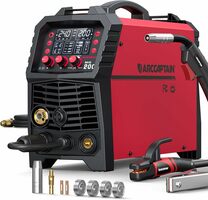 ARCCAPTAIN
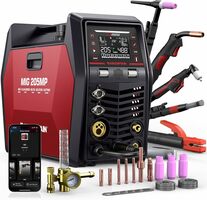 ARCCAPTAIN