Vibration platform machines have moved well beyond gym novelty status — they're now a fixture in home gyms, rehabilitation settings, and senior wellness routines, offering a low-impact way to engage muscles, support balance training, and complement recovery work. The appeal is straightforward: you stand (or sit, or perform exercises) on a motorized platform, and the vibration causes your muscles to contract repeatedly in response. What gets complicated is matching the right machine to your actual goals, because frequency, amplitude, motion type, and platform size all interact in ways that matter far more than price alone. This guide walks you through the decisions that separate a purchase you'll use daily from one that collects dust in the corner.
A quick note on expectations before we dig in: scientific evidence supporting health claims for vibration platforms is still emerging and mixed, so it pays to set realistic expectations going in. Results vary significantly between individuals, and no specific outcome is guaranteed.
Who Should Consider a Vibration Platform?
Vibration platforms aren't for everyone, but they suit a surprisingly broad range of users — provided the right type is chosen for the right purpose. Before you shop, it helps to know which category you fall into, because that single factor will shape every spec decision that follows.
- Older adults and seniors are among the most common buyers, drawn by the potential for low-impact balance and mobility work. Platforms in the oscillating category, used at lower frequencies, are often paired with stability training and general wellness routines.
- Home gym enthusiasts typically want a supplemental tool for warm-up, muscle activation, or post-workout recovery rather than a primary training method. Mid-range platforms with broader frequency spans give this group the most flexibility.
- Rehabilitation-adjacent users — those managing muscle weakness, swelling, or post-injury recovery — often find value in low-amplitude oscillating platforms. A vibration platform is not a substitute for professional medical treatment or structured physical therapy, so think of it as a complement to a clinician-guided plan, not a replacement.
- Athletes and performance-focused users generally gravitate toward linear or dual-mode machines for higher-intensity muscle activation and warm-up protocols, and prioritize a wider frequency ceiling and sturdier build quality.
- Small-space and apartment dwellers have the tightest set of constraints: footprint, noise, and floor vibration transmission all become purchase-critical factors in ways they aren't for someone with a dedicated home gym.
Motion Types: Oscillating, Linear, and Dual-Mode
The single most important decision you'll make when buying a vibration platform is choosing the right motion type. Each produces a fundamentally different stimulus, and buying the wrong one for your goals means the specs almost don't matter.
- Oscillating (pivotal) platforms use a seesaw-style tilting motion, alternating the left and right sides of the platform like a slow pendulum. This mimics the natural gait pattern of walking and is the most widely recommended starting point for beginners, older adults, and anyone focused on balance or gentle recovery work. The alternating movement tends to feel less jarring at equivalent frequencies than vertical motion.
- Linear (vertical or tri-planar) platforms drive the entire surface up and down simultaneously, delivering a more direct, uniform stimulus to the whole body. Athletes and fitness-oriented users prefer this motion for muscle activation, as the force is applied more evenly and intensely. It is generally considered higher-impact than oscillating motion at comparable settings.
- Dual-mode platforms combine both motion types, letting you switch between oscillating and linear depending on the session. This versatility comes at a higher price, but if your goals shift between recovery and performance training, it removes the need to ever compromise.
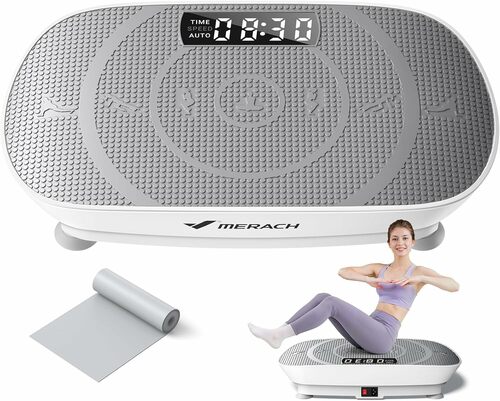
- Compact portable plates are lightweight, low-profile, and budget-friendly, but they typically sacrifice amplitude range and weight capacity in the process. They're a reasonable starting point for light, occasional use but tend to underperform for anyone training regularly or above average body weight.
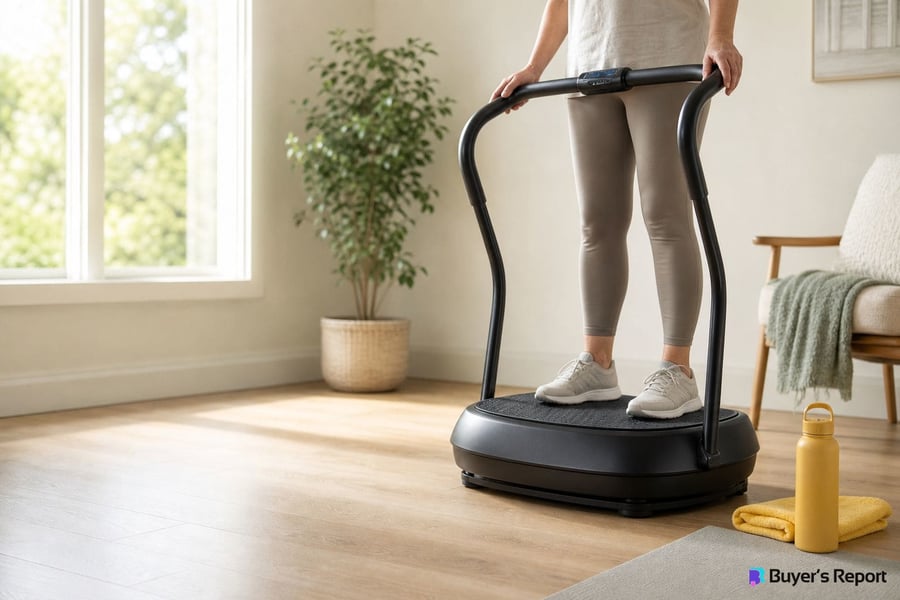
- Full-size platforms with handlebars add a stability bar to the equation, which is a meaningful feature for users managing balance issues or those new to vibration training who want something to hold while they find their footing.
Decoding Frequency and Amplitude
Two numbers define how intense a vibration session actually feels: frequency (measured in Hz) and amplitude (measured in mm). Retailers sometimes treat higher numbers as a universal selling point, but higher frequency or amplitude isn't automatically better — matching specs to your goal and fitness level matters far more than chasing the ceiling.
- Frequency: 15–25 Hz sits in the beginner and balance-training range. Sessions at these lower settings are gentler and are commonly referenced in rehabilitation and senior wellness contexts. If your primary goal is stability work or you're new to vibration training, you don't need a machine that pushes past this range.
- Frequency: 25–35 Hz is the moderate-to-higher range associated with strength activation and more demanding muscle engagement. Athletes and intermediate users should look for machines that can comfortably reach this band with stable, consistent output.
- Amplitude: 1–2 mm delivers a gentler vibration that's easier on joints and commonly referenced in bone health and recovery protocols. It's the right spec for users who are older, new to vibration, or managing sensitivities.
- Amplitude: 2–4 mm provides a more intense stimulus and broader application for strength-oriented use. Users focused on muscle activation or athletic performance should target this range, but only if the motion type and their fitness level support it.
Platform Size, Weight Capacity, and Space Fit
A vibration platform has to physically accommodate you — your foot stance, your body weight, and your room — before any of the specs become meaningful. These are the practical constraints that narrow your shortlist quickly.
- Weight capacity baseline is one of the clearest signals of build quality. Check that the platform's rated weight capacity safely exceeds the user's body weight rather than just matching it — a machine operating at or near its structural ceiling will wear faster and may flex underfoot. A listed capacity of at least 300 lbs is a reasonable baseline indicator of structural integrity for most adult users.
- Platform surface size needs to comfortably fit a shoulder-width stance. If the surface is too narrow, you'll be compensating with your footing on every session, which undermines the stability work you're trying to accomplish.
- Footprint and storage matter especially in apartments and smaller homes. Full-size models with handlebars can be significantly larger than compact plates, and some don't fold. Measure your available floor space before you fall in love with a model.
- Noise and floor transmission are critical for anyone in an apartment building or using the machine early in the morning. Oscillating platforms tend to transmit less vibration to the floor than linear models at equivalent settings. Reading user reviews specifically about noise and floor shake will tell you more than the spec sheet alone.
Safety Features and Who Should Check With a Clinician First
Vibration platforms are powered fitness devices, and there are specific safety considerations worth confirming before purchase — not just after the box arrives. Certain medical conditions and implants can make vibration training a poor fit, including pacemakers, joint implants, pregnancy, acute injuries, epilepsy, and blood clots; anyone in those categories should talk to a qualified healthcare professional before using one.
- Emergency stop or remote controls are a meaningful safety feature, particularly for older users or anyone with balance concerns. Confirm whether a handheld remote or auto-stop function is included — having to step off the platform to power it down isn't ideal mid-session.
- Non-slip surface quality should be confirmed in reviews, not just assumed from product photos. Textured rubber platforms perform very differently from smooth ones, especially as intensity increases.
- Warranty coverage is a proxy for manufacturer confidence in the motor and frame. A minimum of one year is the floor; two to three years on the motor and structural components indicates a more durable, better-supported build. Budget models with 90-day warranties often reflect that short expected lifespan.
- CE or UL certification on the electrical components confirms that the machine has met recognized safety standards. Verify this on the spec sheet or in the product documentation before purchasing, particularly from unfamiliar sellers.
Bottom Line
A vibration platform can be a genuinely useful addition to a home gym or wellness routine — but only if the motion type, frequency range, and amplitude align with what you're actually trying to accomplish. Beginners and older adults should prioritize oscillating motion and lower amplitude; athletes and performance-focused users should look toward linear or dual-mode machines with a broader frequency range. Always verify that the weight capacity exceeds your body weight, pay attention to real-world noise reports if you're in an apartment, and treat warranty length as a rough guide to build quality. Match the machine to your goals and your space, and you'll get far more value than any spec number alone can promise.

 MERACH
 MERACH
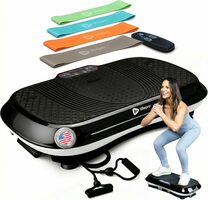 LifePro
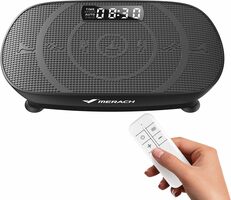 MERACH